The Prison of the Mind
⚔️ The Bound Woman
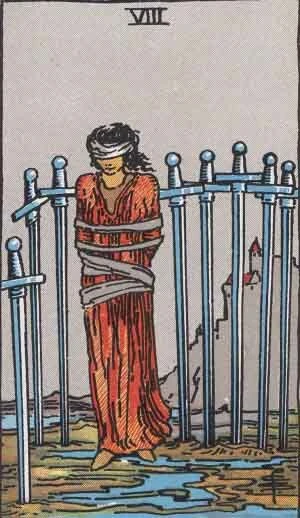
The Eight of Swords presents one of tarot's most psychologically complex images: a woman stands blindfolded and loosely bound, surrounded by eight swords planted in the marshy ground. In the background, a castle sits on a hill—civilization, help, possibility—but she cannot see it. Water pools at her feet, suggesting emotional overwhelm. To the casual observer, she appears utterly trapped. But look closer: her bonds are loose. Her feet are free. The swords form a fence, not a cage. If she could only remove her blindfold, she would see the path to freedom.
This is the card of self-imposed imprisonment. The Eight of Swords asks us to examine the ways we trap ourselves—through fear, through negative self-talk, through beliefs we've internalized about what's possible for us. The woman's captivity is real to her, and the tarot doesn't dismiss that reality. But it does suggest that the keys to freedom are closer than they appear, often requiring only a shift in perception to become visible.
💖 Love and Relationships
In love readings, the Eight of Swords often indicates feeling trapped in a relationship or pattern. This might be a partnership that has become restrictive, or it might be your own fears and beliefs that keep you from experiencing love fully. The blindfold represents the ways we refuse to see our situations clearly—staying with partners who diminish us, repeating patterns that don't serve us, telling ourselves we have no choice when choice is always present.
Sometimes this card appears for those who feel they "can't" leave a relationship, whether due to financial dependence, fear of being alone, concern for children, or simply habit. The Eight of Swords acknowledges the real difficulty of such situations while also suggesting that more options exist than you can currently see. The question isn't whether you can leave (or stay, or change)—it's what beliefs are blinding you to your actual choices.
Reflection questions: What beliefs about love or relationships are limiting me? Am I staying in a situation because I choose to, or because I believe I must? What would I see if I removed my blindfold? What fears keep me from seeing my options clearly?
💼 Career and Finances
In career contexts, the Eight of Swords typically indicates feeling stuck—trapped in a job you hate, unable to find new opportunities, blocked by circumstances that seem insurmountable. The card often appears when imposter syndrome is at play, when we convince ourselves we're not qualified for better opportunities, or when fear of the unknown keeps us in familiar misery rather than risking change.
Financially, this card can suggest feeling trapped by debt, expenses, or circumstances that seem to allow no movement. But like all Eight of Swords situations, the invitation is to examine what's really true versus what you believe to be true. Are there options you haven't explored? Resources you haven't considered? Sometimes our mental limitations create practical limitations that wouldn't otherwise exist.
Career guidance: The Eight of Swords asks you to question the stories you tell yourself about your professional limitations. "I can't leave this job" might actually mean "I'm afraid to leave this job." "There are no opportunities" might mean "I haven't been willing to look." The card doesn't promise that change will be easy, but it insists that change is possible—if you're willing to remove the blindfold and see your situation clearly.
🌌 Spiritual Significance
Spiritually, the Eight of Swords represents the ways our thoughts create our reality—and specifically, how negative or fearful thinking can construct elaborate prisons that exist nowhere except in our minds. Every belief we hold acts as either a door or a wall. The beliefs we've absorbed about who we are, what we deserve, and what's possible for us determine the shape of our lives more than any external circumstance.
The blindfold is crucial. It represents not just ignorance but willful not-seeing—the ways we avoid looking at truths that would require us to change. Sometimes we prefer the familiar prison to the unknown freedom. Sometimes we've been in captivity so long we've forgotten we're capable of walking out. The Eight of Swords asks whether you're ready to see—truly see—your situation, even if what you see requires action you've been avoiding.
This card also speaks to the spiritual practice of questioning our thoughts. Not every thought is true. Not every fear is founded. The mind generates endless scenarios, most of which never come to pass. Learning to recognize the difference between reality and mental projection is one of the most liberating skills we can develop. The Eight of Swords is an invitation to begin that work.
⚡ The Shadow Side
The shadow of the Eight of Swords is finding comfort in victimhood. Some people become so identified with being trapped that they resist any suggestion of freedom. The prison becomes familiar, even safe. If we're victims of circumstance, we don't have to take responsibility. If we're helpless, we don't have to try. The shadow uses helplessness as a shield against the risk and effort of change.
Another shadow expression is learned helplessness—having tried and failed so many times that we stop trying altogether. The swords become not just a fence but a fortress, and we tell ourselves we prefer it inside. We might even attack those who suggest that freedom is possible, so threatening is the idea that our imprisonment might be partly of our own making.
The deepest shadow is using the Eight of Swords energy to stay in situations that harm us or others. Abusive relationships, destructive addictions, toxic work environments—we know we should leave, but we convince ourselves we can't. The blindfold becomes a way of not seeing the damage we're allowing or causing. The invitation of this card is to remove the blindfold even when—especially when—what we see demands difficult change.