The Outcasts in the Snow
❄️ The Stained Glass and the Cold
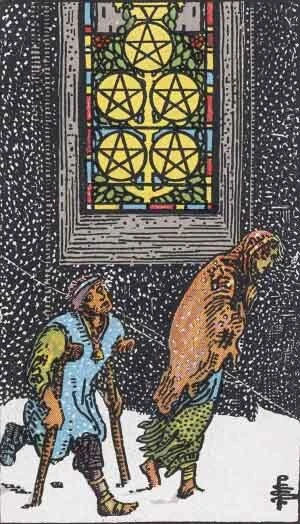
The Rider-Waite illustration presents one of tarot's most poignant images: two figures struggle through snow, passing beneath a brilliantly lit stained glass window depicting five golden pentacles. One figure walks on crutches, bandaged and wounded; the other is barefoot, wrapped in a thin shawl against the bitter cold. They are clearly destitute, excluded, suffering.
Yet the warmth and light of the church window blazes above them—help is literally within reach, if only they would look up or knock. This is the profound paradox of the Five of Pentacles: we often suffer alone while help stands waiting, unseen because we're too focused on our pain, too proud to ask, or too convinced we're unworthy of sanctuary.
💖 Love and Relationships
In love readings, the Five of Pentacles speaks of difficult times—feeling alone even within a relationship, experiencing rejection, or struggling with the material pressures that strain partnerships. It can indicate a relationship under financial stress, partners who have grown emotionally distant, or the painful isolation that comes from feeling unsupported by those who should care for us.
This card often appears when someone feels left out in the cold—rejected, abandoned, or struggling alone with burdens that should be shared. It asks: are you truly alone, or have you closed yourself off from the support that's available? Are you walking past the lit window because you believe you don't deserve warmth?
Reflection questions: Am I reaching out to those who could help, or suffering in silence? Have I rejected support before it was offered? What would it take to knock on the door and ask for shelter?
💼 Career and Finances
This is the card of financial hardship in its most direct form—job loss, business failure, poverty, debt, or the struggle to survive when resources are scarce. When the Five of Pentacles appears in a career reading, it often signals a difficult period of material insecurity. Bills may be mounting, savings depleted, and the future uncertain.
Yet like all fives in tarot, this card represents a challenge to be moved through, not a permanent state. The figures in the card are walking—they haven't given up, haven't collapsed. And crucially, the lit window above suggests that resources, help, or opportunities exist that perhaps haven't been explored. Community aid, government assistance, the kindness of friends—the Five of Pentacles asks whether all doors have truly been knocked on.
Career guidance: Hard times are real, but so is the tendency to struggle alone when help is available. This card counsels examining not just your circumstances but your beliefs about asking for and receiving help. Pride can keep us in the cold.
🌌 Spiritual Significance
Spiritually, the Five of Pentacles represents the "dark night of the soul"—those periods of profound spiritual crisis where we feel abandoned by the divine, cut off from meaning, walking through a cold world without guidance or comfort. These are the times when prayers seem to bounce off heaven's ceiling, when faith feels hollow, when we wonder if we've ever truly been held.
Yet the stained glass window tells another story. The five pentacles arranged in the form of a sacred symbol—sometimes seen as the Tree of Life—glow with warm light above the suffering figures. The divine hasn't abandoned them; they're simply not looking up. Their suffering, real as it is, has narrowed their vision to the snow at their feet.
The spiritual teaching here is that hardship is part of the path, not proof of abandonment. The figures outside the church may ultimately enter and find sanctuary. Their journey through the cold may be exactly what brings them to the door. Sometimes we must experience lack to truly understand abundance.
⚡ The Shadow Side
The shadow of the Five of Pentacles is the victim mentality—the insistence on suffering, the rejection of help, the belief that one is uniquely cursed or unworthy of support. In this shadow, we walk past lit windows not because we don't see them, but because we've decided in advance that we don't deserve their warmth, or that accepting help would somehow diminish us.
Another shadow is the use of suffering as identity—becoming so attached to our role as the struggling one, the excluded one, the unlucky one, that we unconsciously sabotage opportunities for improvement. If our whole story is built on hardship, what happens when hardship ends? Some people fear healing more than they fear remaining wounded.
The deepest shadow here is the belief that material lack equals spiritual unworthiness—that poverty is punishment, that suffering proves we're unloved by the universe. This toxic belief keeps many people in the cold, convinced that they must deserve their fate. The Five of Pentacles, rightly understood, challenges this notion: the light shines for all, regardless of their circumstances.