The Merchant's Balance
⚖️ The Scales of Generosity
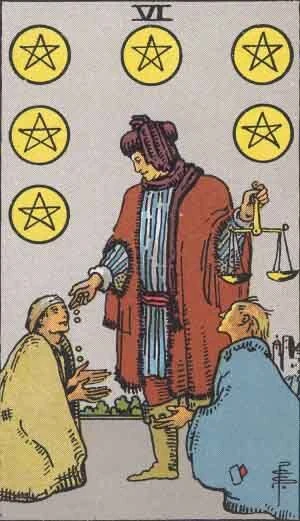
In the Rider-Waite illustration, a wealthy merchant stands holding scales in one hand while distributing coins to two kneeling beggars with the other. The scales represent fairness and careful measurement—this is not reckless giving, but thoughtful distribution. The merchant's fine clothes and upright posture convey prosperity and authority, while the kneeling figures represent those in need.
The Six of Pentacles captures a moment of material exchange that carries profound spiritual implications. It asks us to consider our relationship with wealth, power, and generosity. Who are we in this image? Are we the giver, the receiver, or perhaps both at different times? The card reminds us that abundance flows in cycles—sometimes we give, sometimes we receive, and both are necessary parts of the dance.
💖 Love and Relationships
In love readings, the Six of Pentacles speaks to the balance of giving and receiving in relationships. Healthy partnerships require mutual support—both partners giving generously and receiving gracefully. This card often appears when a relationship is in good balance, with both people contributing to each other's wellbeing and growth.
However, this card can also highlight imbalances. Is one partner always giving while the other only receives? Does generosity come with expectations attached? The Six of Pentacles asks us to examine whether love flows freely in both directions, or whether there's a power dynamic at play where one person holds the resources (emotional or material) and doles them out.
Reflection questions: Is my relationship balanced in giving and receiving? Do I give freely, or with strings attached? Can I receive gracefully, or do I always need to be the provider?
💼 Career and Finances
This is one of the most favorable cards for financial matters. The Six of Pentacles often heralds raises, bonuses, loans being approved, or financial help arriving when needed. It can indicate receiving a grant, scholarship, or inheritance. In business, it suggests fair dealings, profitable exchanges, and the kind of generosity that builds long-term relationships.
The card also speaks to mentorship and the sharing of knowledge as a form of wealth. Perhaps you're in a position to help others advance in their careers, or perhaps someone is opening doors for you. The Six of Pentacles reminds us that success shared is success multiplied—helping others rise often elevates us as well.
Career guidance: The Six of Pentacles encourages examining your relationship with money and power. Are you compensated fairly for your work? Do you share your success with others? This card suggests that generosity—whether giving or receiving—creates positive karma that returns manifold.
🌌 Spiritual Significance
Spiritually, the Six of Pentacles represents karma in its purest form—the understanding that what we give returns to us, and what we receive creates responsibility. The merchant with his scales evokes the ancient concept of divine justice, where all exchanges are ultimately balanced across time and lifetimes.
This card invites us to give without attachment to outcome, to share abundance as it flows through us rather than hoarding it. It also asks us to receive with grace and gratitude, recognizing that accepting help when needed is itself a gift to the giver. The spiritual practice here is to become a clear channel for abundance rather than a dam that blocks its flow.
The Six of Pentacles also raises questions about worthiness. Notice that the beggars kneel—there's an inherent power dynamic in charity. The spiritual invitation is to give in ways that honor the dignity of the receiver, and to recognize that fortune's wheel turns: today's giver may be tomorrow's receiver.
⚡ The Shadow Side
The shadow of the Six of Pentacles is giving with strings attached—the gift that creates obligation, the charity that demeans, the generosity that's really about power and control. This shadow appears when we give to feel superior, to create dependency, or to manipulate others into owing us.
Another shadow is the inability to receive—the pride that refuses help, the belief that accepting support makes us weak or indebted. This shadow keeps us in isolation, refusing the natural flow of abundance because we can't bear to be in the receiver's position.
The deepest shadow here is the use of money as a tool of control. The merchant in the card decides who receives and how much—this power can be used wisely or abused. When we tie our giving to conditions, expectations, or the need for gratitude, we've crossed from generosity into manipulation. True giving, like true love, expects nothing in return.