The Hollow Victory
⚔️ The Smirking Victor
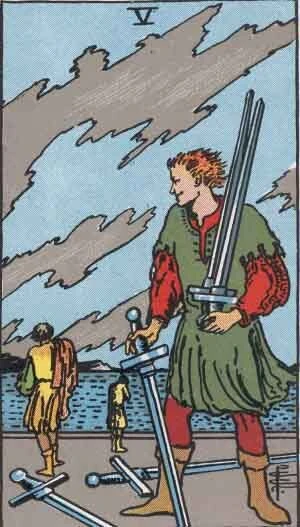
The Five of Swords depicts a scene of aftermath: a figure in the foreground holds three swords with a smug, self-satisfied expression, while two other figures walk away in defeat, their postures conveying dejection and shame. Two more swords lie on the ground—dropped, surrendered, or perhaps taken. The sky is turbulent, yellow-green with storm clouds, suggesting that this conflict has left the atmosphere poisoned.
The central figure has clearly "won," but look at what he's won: empty swords, departed allies, and a battlefield strewn with the remnants of relationship. His smirk reveals the shadow of victory—the hollow satisfaction of defeating others rather than achieving something meaningful. The departing figures don't look back; whatever bond existed has been severed. This is the card of winning the battle but losing everything that mattered.
💖 Love and Relationships
In love readings, the Five of Swords is rarely welcome. It often indicates conflict where someone is prioritizing being right over being in relationship, where arguments have become about winning rather than understanding. One partner may be using cruel words as weapons, going for the jugular in fights, saying things that can't be unsaid. The card asks: what good is winning an argument if you lose your partner's trust?
This card can also indicate betrayal, infidelity discovered, or the aftermath of a relationship that ended badly. Someone may be gloating over causing pain, or someone may be walking away humiliated. In some cases, it points to a relationship with a person who always needs to dominate, who can never admit fault, who treats love as a competition to be won.
Reflection questions: Am I fighting to win or fighting to understand? Have I said things in anger that damaged trust? Is this relationship bringing out my worst competitive instincts? What would happen if I chose connection over being right?
💼 Career and Finances
In career contexts, the Five of Swords often indicates workplace conflict that has turned toxic. This might be office politics where someone is willing to sabotage others to get ahead, a hostile work environment, or unethical competition. The card can represent that coworker who takes credit for others' work, the boss who rules through intimidation, or the corporate culture that rewards ruthlessness.
Financially, this card warns against deals or partnerships where someone is clearly trying to take advantage. It might indicate a negotiation where the other party is acting in bad faith, or a financial victory that comes at the cost of reputation or relationships. The Five of Swords asks whether short-term gain is worth long-term damage to your professional relationships and integrity.
Career guidance: The Five of Swords invites you to consider whether you want to work in an environment where this kind of conflict is normalized. Sometimes the wisest choice is to walk away, like the figures in the background—to refuse to play a game where winning requires becoming someone you don't want to be.
🌌 Spiritual Significance
Spiritually, the Five of Swords represents the ego's tendency to turn everything into competition—the need to be right, to win, to dominate. This is the shadow side of the intellectual air element: using mental acuity not for truth-seeking but for verbal dominance, not for understanding but for conquest. The card asks us to examine where our clever minds have been employed in service of ego rather than wisdom.
The departing figures represent what we lose when we prioritize winning: connection, community, the respect of others. The victor stands alone with his collected swords—symbols of ideas, arguments, "points" scored. But ideas disconnected from relationship become hollow trophies. The spiritual lesson is that some victories aren't worth winning, that some conflicts are better resolved through surrender than conquest.
This card often appears when we need to learn humility through defeat. Sometimes the universe arranges for us to lose precisely so we can discover what's more important than winning. The Five of Swords can be a teacher of last resort, showing us through painful experience what we refused to learn through wisdom.
⚡ The Shadow Side
The shadow of the Five of Swords is taking pleasure in others' defeat—not just winning but needing others to lose, not just succeeding but needing others to fail. This is the energy of the bully, the troll, the person who feels bigger only when making others feel small. The smirking figure in the card embodies this shadow: his satisfaction comes not from achievement but from domination.
Another shadow expression is chronic victimhood—always being the one walking away defeated, always losing conflicts, always feeling dominated by others. This pattern might indicate a need to develop healthy assertiveness, to learn that standing up for oneself isn't the same as becoming the aggressor. The Five of Swords can trap us on either side of the dynamic.
The deepest shadow is the belief that life is zero-sum, that for you to win someone else must lose. This worldview creates the very conflicts it expects to find, turning potential collaborators into competitors, potential friends into enemies. The Five of Swords asks us to question whether we're creating unnecessary battles through our assumptions about how the world works.