The Sacred Pause
⚔️ The Knight at Rest
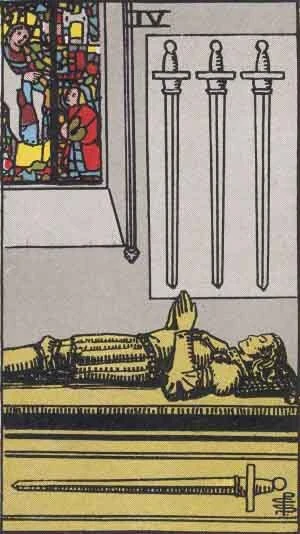
The Four of Swords depicts a knight lying in perfect stillness upon a tomb within a church or chapel. His hands are pressed together in prayer, and his body lies in the position of medieval tomb effigies—the eternal rest of the honored dead. Yet this is not death but deliberate withdrawal. Three swords hang on the wall behind him while one lies beneath his resting place, suggesting that he has temporarily set aside his weapons, his battles, his mental struggles.
A stained glass window illuminates the scene, showing a figure offering blessing to a kneeling supplicant. This sacred space represents sanctuary—a place apart from the world's demands where healing can occur. The stone walls protect him from external chaos; the quiet atmosphere allows his overworked mind to finally rest. After the heartbreak of the Three of Swords, this card offers medicine: the wisdom to stop, to retreat, to recover before continuing.
💖 Love and Relationships
In love readings, the Four of Swords often indicates a necessary pause in romantic matters. This might be time apart to heal from relationship wounds, a period of celibacy or dating withdrawal to recover from heartbreak, or simply the need to step back and reflect before making important relationship decisions. The card doesn't indicate the end of love—rather, it suggests that love can only flourish when we're not depleted.
For those in relationships, this card may indicate a period where one or both partners need space. This isn't rejection but recognition that individuals need time for themselves even within partnership. It might suggest a retreat together—time away from daily stresses to reconnect—or time apart to process individual issues that can't be resolved through constant togetherness.
Reflection questions: Do I need time alone to heal before I can be fully present in relationship? Am I giving my partner the space they need for their own inner work? Have I been avoiding solitude because I'm afraid of what I might find there?
💼 Career and Finances
In career contexts, the Four of Swords is often a clear message: you need rest. This might mean taking that vacation you've been postponing, using your sick days for mental health, or recognizing that pushing through exhaustion is counterproductive. The card appears frequently for those approaching or recovering from burnout, reminding them that rest is not laziness but necessity.
Financially, this card can indicate a period of consolidation rather than expansion—a time to stabilize rather than take new risks. It may suggest stepping back from financial stress and anxiety to gain perspective. Sometimes the best financial decision is to stop making decisions for a while, to let the dust settle before charting a new course.
Career guidance: The Four of Swords asks whether you're treating rest as optional or essential. In a culture that glorifies constant productivity, this card is radical: it insists that doing nothing is sometimes the most important thing you can do. What would happen if you truly rested?
🌌 Spiritual Significance
Spiritually, the Four of Swords represents the contemplative traditions found in every wisdom path: meditation, retreat, the deliberate withdrawal from worldly activity to cultivate inner awareness. The knight's prayerful posture suggests that this rest is not passive but actively receptive—he is listening for something that can only be heard in silence.
The church setting reminds us that rest can be sacred, that withdrawal from activity can be a form of devotion. Many spiritual traditions include periods of retreat, silence, or sabbath—recognition that the soul needs fallow time just as fields do. The Four of Swords invites us to create sanctuary in our lives, spaces and times set apart from the world's demands.
This card often appears when the mind has been overactive, when we've been living too much in our heads and need to drop into a different way of knowing. The swords on the wall represent thoughts we can choose to set aside; the horizontal position represents the shift from doing to being. Sometimes spiritual growth requires us to stop seeking and simply rest in what we already are.
⚡ The Shadow Side
The shadow of the Four of Swords is using retreat as avoidance—hiding from life rather than recovering for it. Rest becomes escape, sanctuary becomes prison. The person who retreats into isolation not to heal but to avoid the challenges of engagement may find that their "rest" never ends, that they're always preparing for a life they never actually live.
Another shadow expression is refusing rest altogether. The reversed Four of Swords often indicates someone who cannot stop, who has become so identified with activity that stillness feels like death. This person may need to crash before they'll rest—burnout, illness, or crisis forcing the pause they wouldn't take voluntarily.
The deepest shadow is believing that rest must be earned, that we're only allowed to stop when we've accomplished enough. This perfectionism keeps us on an endless treadmill where "enough" is always just out of reach. The Four of Swords challenges this belief: rest is not a reward for productivity but a requirement for sustainable existence. The knight rests not because he has won all his battles but because resting is how he will remain capable of fighting the ones that matter.